
 Madina S.
When it comes to the use of feedback in management – the performance of the teams, in particular, is a topic of discussion. Meanwhile, 360-degree feedback is currently the feedback method being utilized most frequently. Why is this tactic critical for a manager to have in their skill set?
360-degree feedback involves gathering anonymous feedback from various sources to provide constructive criticism and insight into unmeasurable skills. It is our pleasure to give you a detailed guide on how you can apply 360-degree feedback to managers so that you can have a starting point.
What is 360-degree feedback?
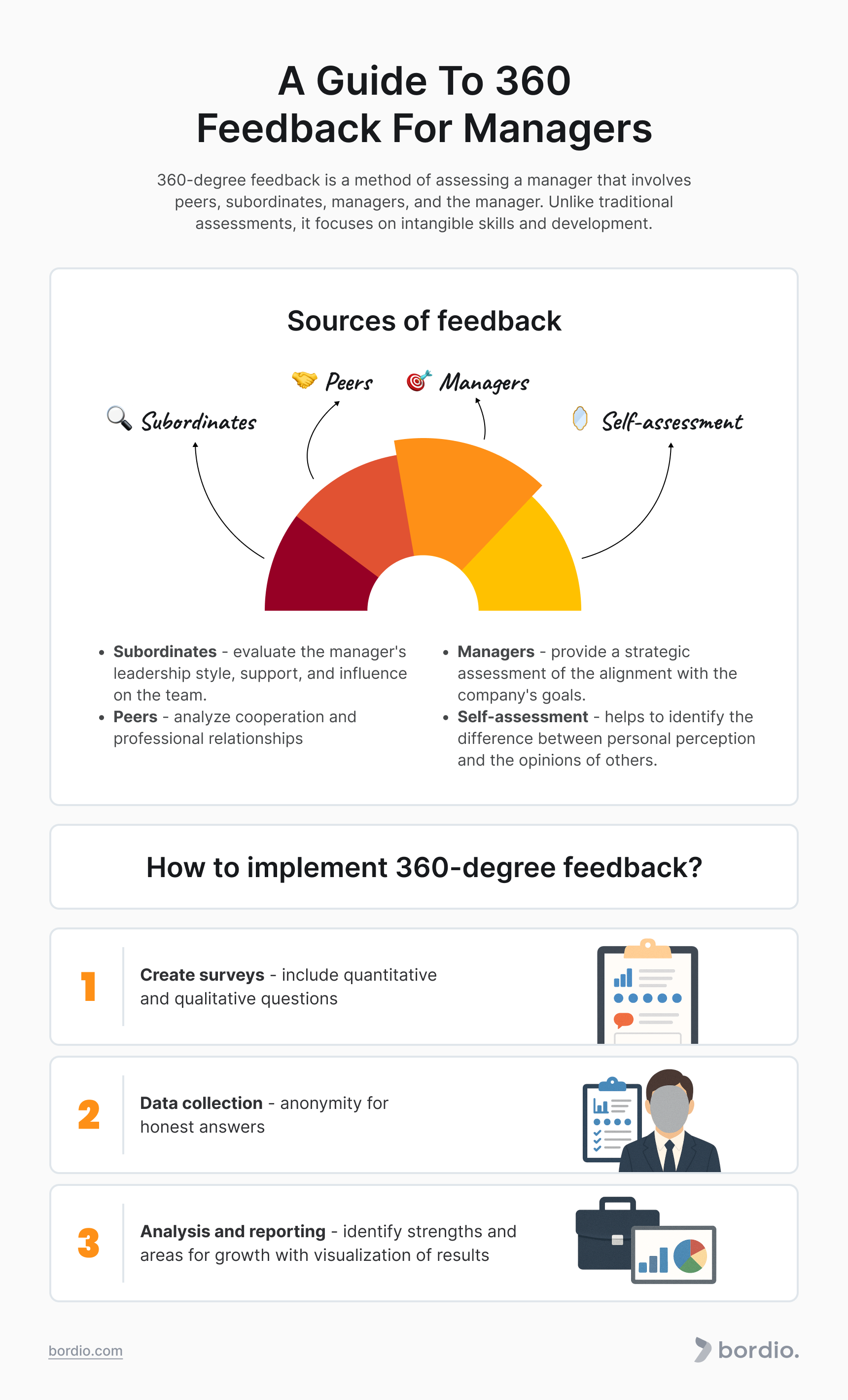
A process known as the 360-degree feedback technique evaluates a manager’s performance; it involves responses from peers, subordinates, the manager’s superior, and the manager himself/herself.
Unlike traditional performance reviews like Sprint reviews that focus on employee performance, 360-degree feedback is not meant to evaluate measurable achievements but rather to provide insight into unmeasurable skills and personal development. This detailed feedback is more informative and precise in describing the manager’s strengths and weaknesses.
Sources of feedback:
There are four primary sources of receiving feedback:
Subordinates:
Indeed, the subordinates’ point of view reveals the manager’s support level, specific team-building ability, and successful daily leadership pattern. This feedback is crucial as it exhibits how the manager influences, organizes, and sustains the employees, resulting in a solid and efficient team.
They can also discuss the extent to which the manager is capable of motivating and directing subordinate employees, the extent to which they provide sufficient items and guidance to team members, aspects of the warm and friendly communications climate that the manager cultivates, and the extent to which the manager communicates expectations, outcomes, or feedback to the team.
Colleagues:
Subordinates of similar rank from one team (you can find out how much they work together in the collaboration tool if you need to) assess the manager’s cooperation, teamwork, and work with employees of the same level. This evaluation emphasizes the manager’s interpersonal skills and professional relationships with other workers.
This also shows information when the manager works well or poorly with other managers and organizational departments, how the manager deals with disagreements and conflicts with other managers, what punctuality and reliability the manager has in doing what they promise, and how supportive the manager of the employee is in helping all to realize various organizational objectives.
Managers:
Organizational authorities have management perceptions that are broader, systematized, and more strategic than the manager’s actions. On this basis, one is able to determine how successfully the manager meets the corporate requirements of providing support for the organizational goals and objectives.
Tip: You must be interested in the article – How To Set Goals And Achieve Them Fast?
Some of the facts that may be emphasized in the feedback include the extent of reaching the manager’s set target/level of performance, the level of conformity of the decision made to the organization’s strategic plan, the capacity of the manager for any future promotion and their ability to handle more responsibilities; quality of the decision made by the manager and effect of those decisions on the organization.
Self-Assessment:
Self-assessment can also be helpful to managers because sometimes they may discover their assets and set themselves up for areas that require improvement. The managers might also unearth cultural disparities between their self-assessments and the ways people perceive them based on the feedback they receive from others.
How do you conduct 360-degree feedback?
Having understood what 360-degree feedback is, we now have time to begin implementing it in the workplace! It is important to note that 360-degree feedback should be used for development rather than as a performance management tool. In particular, how do we accomplish this? Let’s look at it in detail:

Surveys and questionnaires:
Creating surveys covering a range of managerial duties, such as decision-making, team management, leadership, communication, and communication skills, is the first step. The manager’s ability to assign work, foster team cohesiveness, resolve problems, offer assistance, motivate the group, establish clear objectives, communicate, pay attention to issues raised, encourage candid dialogue, and make just choices should all be evaluated.
These surveys should include quantitative questions to assess responses objectively and qualitative questions (e.g., open-ended questions) to get comprehensive feedback.
Data collection:
The surveys should be sent out anonymously to ensure objective and truthful responses. Because anonymity protects their identities, respondents are more likely to speak candidly without fear of repercussions. This encourages honest feedback from different perspectives, which is crucial for accurate and realistic assessments.
To collect this data, online survey platforms must be used to ensure data privacy and confidentiality. Specific data handling policies should be implemented to protect respondent privacy and guarantee that the data is safely maintained and accessible only by authorized persons.
Tip: Some data can be collected from the team’s management tool because such a planner has a lot of helpful info on work and team members.
Analysis and reporting:
When the data is gathered, it is analyzed to find trends, patterns, and areas that might use improvement. While qualitative comments are studied to give deeper insights into particular problems and ideas, quantitative data is provided to highlight noteworthy discoveries.
The results are then compiled into detailed reports that identify opportunities for improvement, showcase strengths, and expose weaknesses. Tables, graphs, and charts are examples of visual aids that effectively display the facts. These reports provide practical suggestions derived from the feedback study. Bordio may make feedback session scheduling, preparation, and delivery more efficient. When you schedule everything using the Bordio time management tool, feedback sessions are organized to ensure all participants are present and prepared.
Among other things, Bordio is a project management tool that helps teams:
- Assign and track tasks
- Communicate with comments and live chat
- Schedule tasks, meetings, and deadlines
- Distribute workload evenly
Examples of 360-degree feedback to strengthen manager emphasis:
Now that the principles and steps necessary to implement 360-degree feedback have been acknowledged, it is essential to understand how this all-inclusive assessment method can enhance managers’ effectiveness. 360-degree feedback assists in the appraisal of an employee’s performance since it involves reviewing and assessing performance aspects such as strengths, weaknesses, and opportunities for improvement.
The cases above show how managers may get feedback from peers, subordinates, and superiors, as well as individual self-assessments, to determine where they are strong and where to improve. From the analysis of these cases, managers may be able to learn how to use 360-degree feedback to enhance group interactions, enhance leadership skills, and bring employee performance in line with organizational objectives. We offer guidance on using feedback constructively to promote professional and personal development.
Positive feedback examples
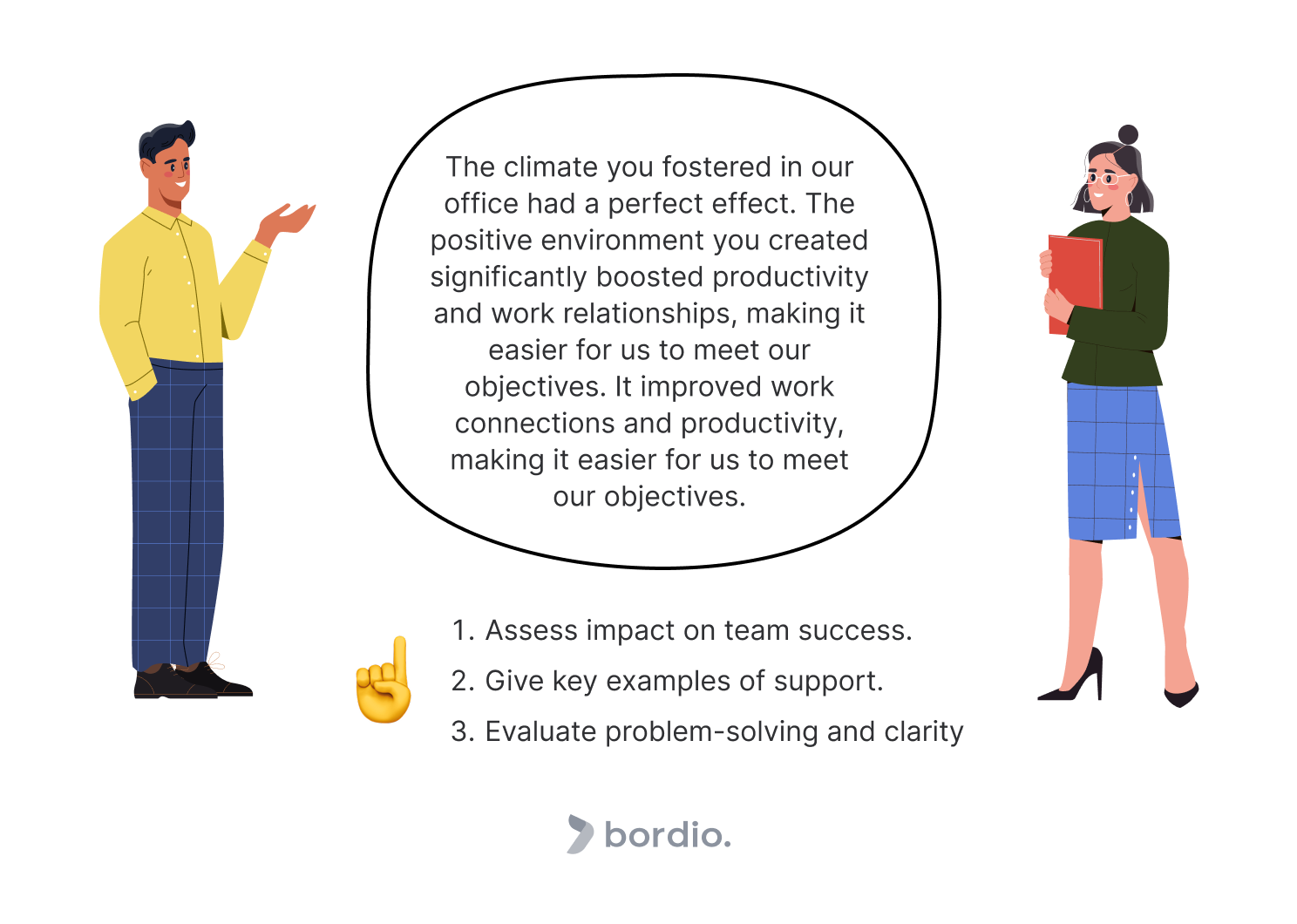
- Assess the manager’s contribution to creating a positive work environment and emphasize how this contributes to the team’s success.
- Highlight specific examples where the manager’s assistance was critical. Explain what you learned from his support. Evaluate the manager’s management style.
- Explain precisely how he helps the team overcome difficulties. Emphasize the importance of clarity in the manager’s communications. Analyze your team’s project management tool to explain how this contributes to successful task completion.
“The climate you fostered in our office had a perfect effect. The positive environment you created significantly boosted productivity and work relationships, making it easier for us to meet our objectives. It improved work connections and productivity, making it easier for us to meet our objectives.”
Negative feedback examples
- Admit there is a problem. Provide possible reasons and suggest ways to improve in the future. Be honest about your workload management difficulties.
- Ask for advice or support. Emphasize the need to balance providing clear instructions and allowing for independent work.
- Explain how this supports learning. Express gratitude for the manager’s initiatives. Point out the need for motivational support and recognition of employee work.
“It astonished me that there was a misunderstanding throughout our most recent assignment. I acknowledge that we were all under a great deal of strain due to the enormous task on our to-do list we had on our hands, which may have contributed to the issue. But because of your advice, we could complete the job on schedule. In any event, I hope that we can communicate more effectively for the following project.”
Leadership feedback
Recognize the impact of a manager’s leadership on the team’s success and motivate the manager to continue in the same spirit.
“Our team has improved and achieved our target thanks to your leadership and direction. You’ve motivated our group to work hard and supported us through various challenges.”
Upward feedback
Emphasize the importance of regular communication to ensure the project’s success. Offer concrete solutions to improve communication.
“I know you’ve been busy recently, but could we meet more frequently while this project is underway? As the customer asked, we must ensure we’re headed in the correct direction.”
Last round: how do you give feedback to your boss?

Giving feedback to your boss can be daunting, but it’s essential for improvement. One on one conversation are crucial for addressing areas for improvement and recognizing strengths, but they can be stressful. At first, you may schedule a meeting in the handy task tracker and focus on these areas:
1. Leadership skills
A good leader provides direction and structure without micromanaging and is open to conversation. Positive feedback in this area can include highlighting instances where your boss leads by example, participates in group activities, and provides clarity in their communication. On the other hand, unfavorable criticism might highlight instances in which they micromanage work, establish unreasonable standards, or display a self-centered mindset that puts their demands ahead of those of the team.
2. Problem-solving skills
Feedback on problem-solving should address the manager’s approach to conflict resolution and finding solutions. Effective problem-solvers directly address conflicts and brainstorm solutions with their team. If your boss redirects blame or lacks accountability, these are important areas to highlight, as they can significantly impact team trust and cohesion.
3. Employee engagement
Effective managers engage with their employees through open-door policies, building trust, and frequent check-ins. Positive feedback might recognize their efforts in these areas, while negative feedback could address issues like poor listening skills, high employee turnover, or inadequate onboarding processes. By emphasizing these areas, you may make your supervisor realize how important creating a welcoming and stimulating work atmosphere is.
Benefits of using 360-degree feedback
As an effective and reliable method of illustrating employee development and performance improvement, the 360-degree feedback process is a reliable technique. Attrition management is also a necessary process that needs human resources’ assistance to provide employees with essential help and opportunities for self-growth. As this paper has shown, self-perception would be more holistic once other people’s feedback is obtained apart from one’s direct supervisors. This concept not only increases the performance of the respective individuals but also directly impacts the overall efficiency and employees’ participation in the company.
Completeness of information
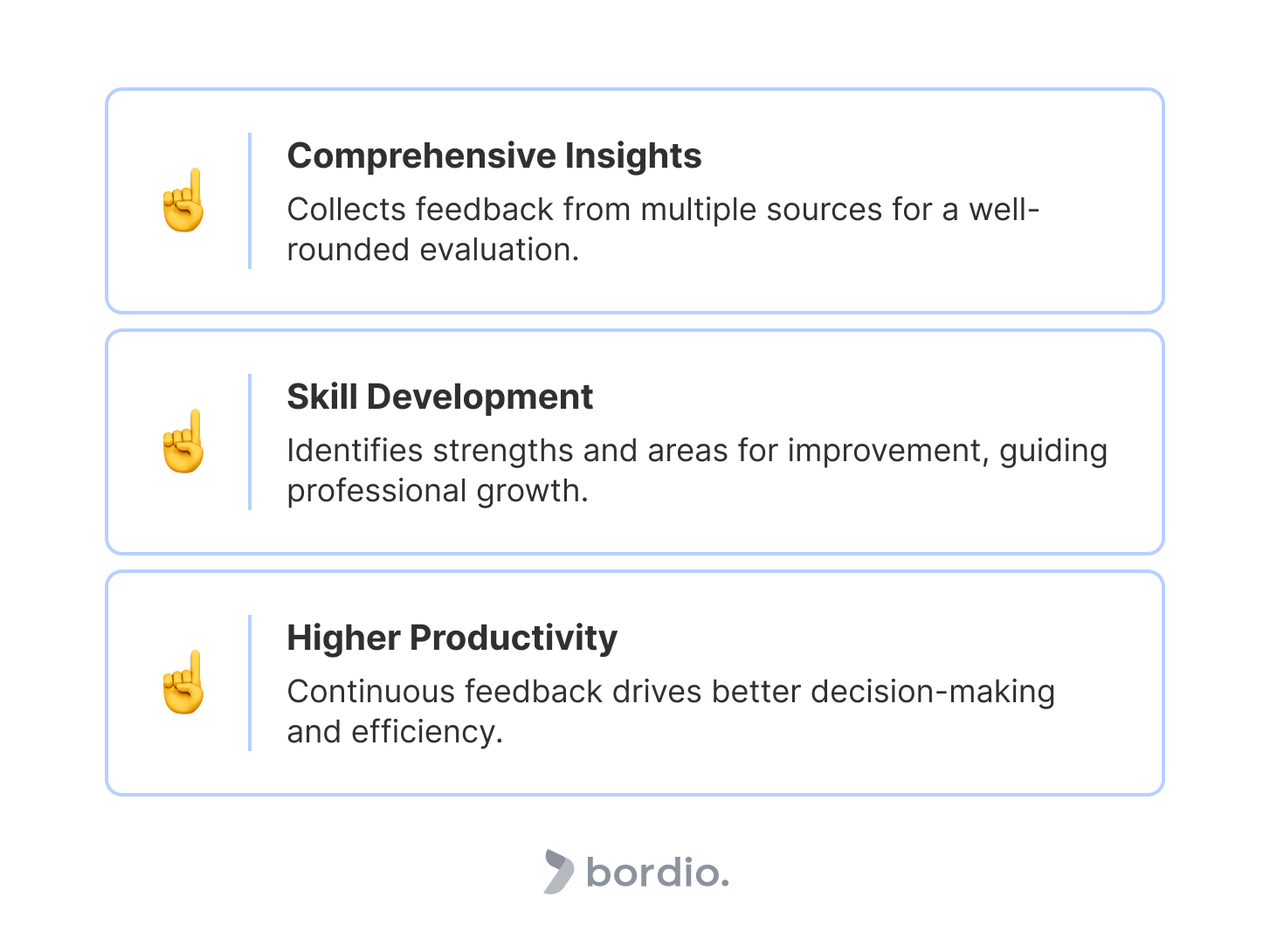
Among the significant strengths of 360-degree feedback is the possibility of collecting vast amounts of data from this method. This keeps the information coming from not only the manager’s subordinates and peers, but also the manager’s superior within the same spectrum, and the self-appraisal part offers a more well-rounded and comprehensive outlook of the manager’s performance. Thus, the evaluation does not give preferences to one kind of source and is rational, providing an opportunity to assess the manager’s skills comprehensively. Performance appraisals become more accurate because of the gathered data, and a relational database makes it easier to uncover trends that would not be visible from another approach.
Skill development
Its function in skill development is an additional significant advantage. 360-degree feedback helps managers realize what skills need to be improved to improve their performance by highlighting strengths and deficiencies. Different types of feedback might point out areas where a manager shines and areas where they may want more guidance or assistance. With the use of this focused information, managers may design individualized development programs that highlight the talents that have the most influence on their success and help them advance professionally.
Increased productivity
Frequent feedback via the 360-degree method encourages performance improvement and ongoing progress. When managers get continuous, actionable feedback, they can make the required real-time changes to their behavior and plans. This iterative process fosters a culture of continuous improvement, where management always aims to improve their performance. That eventually results in increased production as managers improve their ability to manage teams, make choices, and find solutions to issues.
Challenges and solutions for 360-Degree Feedback
Objectivity
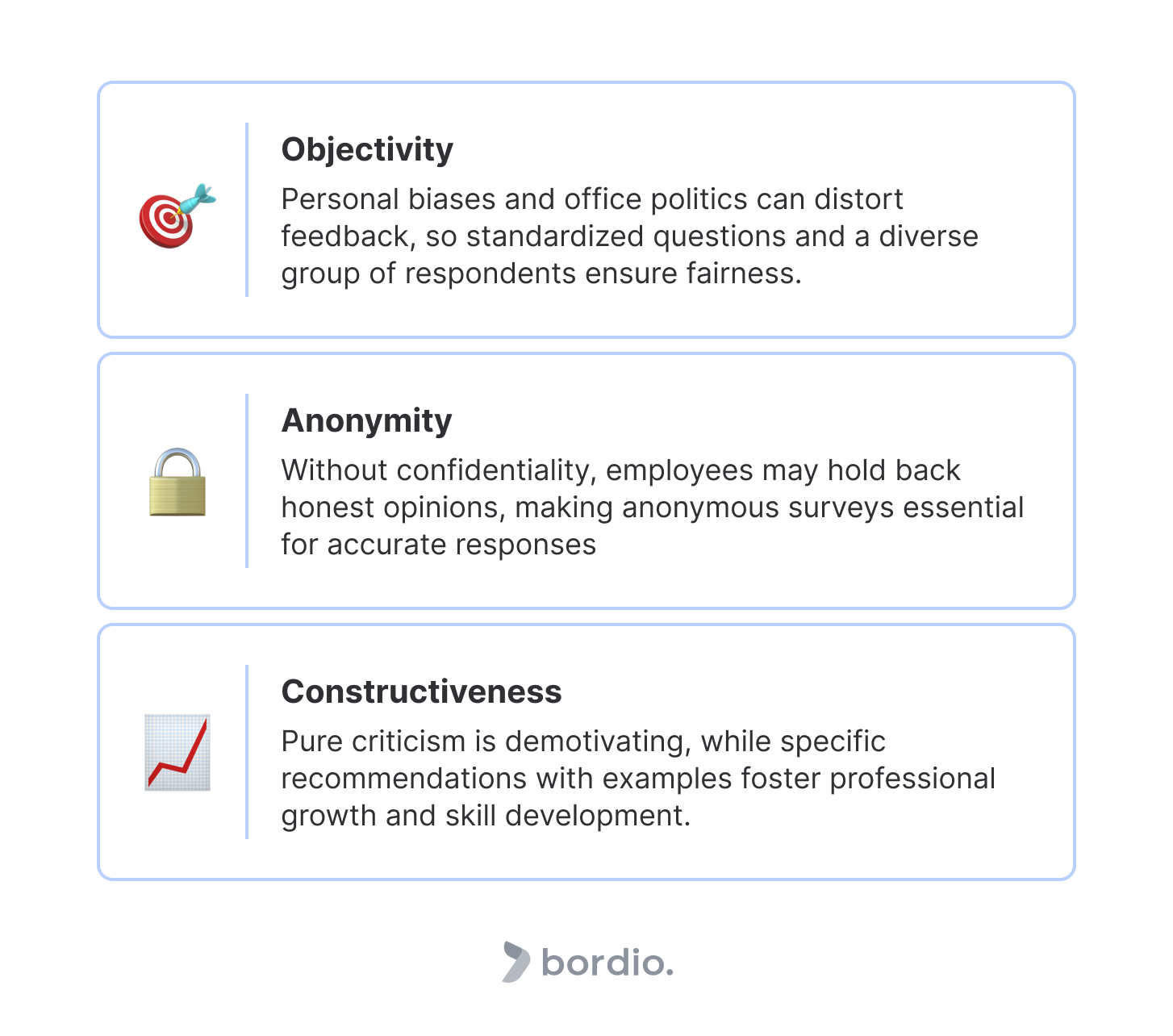
Ensuring participant replies are impartial and devoid of prejudice is one of the primary issues associated with 360-degree feedback. Subjective views, office politics, and personal prejudices can all influence the feedback. It’s critical to plan the feedback process with a specific planning tool. It entails employing standardized questions, protecting participant privacy, and educating them on providing constructive, unbiased feedback. Furthermore, a more accurate overall image may be obtained by balancing individual biases with a wide and varied pool of respondents.
Anonymity
Confidentiality of review must be upheld to avoid unfavorable outcomes and guarantee objectivity. To avoid confrontation, participants may withhold candid criticism or give excellent ratings if they worry their replies may be linked to them. To address this, anonymous survey instruments safeguarding respondents’ identities are critical. Inform participants of the steps to maintain their privacy and give them confidence that their input will be used positively.
Constructive feedback
Giving constructive feedback instead of criticism is essential for the manager’s personal and professional development. Constructive feedback must be practical, precise, and worded to promote development. It should include specific instances and recommendations for improvement rather than just pointing out issues without answers. Giving constructive criticism guarantees that the receiver will see it favorably. You can use the feedback sandwich system to ensure constructive feedback and that no one is offended.
360-degree feedback may be a potent instrument for improving work management performance, developing skill development, and advancing an improvement-oriented culture inside the company if these advantages and difficulties are handled well.
Final Thoughts on 360-degree Feedback for managers:
Provide constructive, sympathetic criticism bolstered by concrete instances. The 360-degree feedback strategy guarantees the value of your comments and fosters a productive working relationship.
Draft a strategy for the manager’s personal growth using the comments obtained. Determine whatever courses and training are required to strengthen the shortcomings found. Highlight and appreciate the manager’s accomplishments to boost morale and contentment at work.
360-degree feedback is a potent instrument for managers’ professional and personal growth, enhancing their ability to lead and the company’s overall performance!




 Jacob Udodov